Floor Insulation
Materials & Technologies
Floor insulation is a critical milestone in designing an energy-efficient, healthy, and comfortable living or commercial space. An uninsulated floor assembly acts as a massive thermal bridge, accounting for up to 15% of a building’s total heat loss. Furthermore, cold floor surfaces are prime catalysts for dampness, interstitial condensation, and hazardous mold growth. Implementing engineered floor insulation systems not only seals radiant heat inside but also establishes a highly durable structural foundation for your final flooring options.
Framed Technology Products

Mineral Insulation Roll
Product Description
Mineral Insulation Roll is a next-generation thermal and acoustic insulation material made from premium glass wool, engineered for maximum energy efficiency and reliability. The material features excellent flexibility and resilience, allowing it to fit tightly into structural frameworks and completely eliminate thermal bridging. Due to its advanced fiber structure, the insulation reliably protects buildings from heat loss and frost, withstands accidental condensation exposure, extends the service life of building assemblies, and provides top-tier structural fire protection.
Product Application
Highly flexible and lightweight, this mineral insulation roll is widely integrated across multi-sector construction workflows for insulation, soundproofing, and fire protection:
- Framed Wall Insulation: Used as a non-combustible interior core in timber and steel-framed buildings.
- Attic & Pitched Roof Insulation: Easily fitted between roof rafters to deliver reliable protection against seasonal frost and exterior airborne noise (rain, wind, traffic).
- Siding & Curtain Wall Systems: Perfectly suited for exterior insulation within ventilated facade systems finished with vinyl/metal siding, architectural glass, or metal cladding panels.
- Balcony & Loggia Insulation: Highly efficient for thermal retrofitting of unheated or semi-open spaces.
- Acoustic Interior Partitions: Deployed inside drywalls and interior partition frames to maximize sound dampening and acoustic compartmentalization in residential apartments.
- Insulation of unused attic floors: The most budget-friendly solution for home thermal insulation, eliminating the need for costly full-roof insulation
- Framed and Non-Load-Bearing Floors/Ceilings: Perfectly optimized for lightweight, non-load-bearing applications, including thermal and acoustic lining installed directly between floor joists, timber ceiling beams, and intermediate floors.
Product Specifications
- Core Material: Glass wool (staple fiberglass fibers)
- Facing Type: Unfaced
- Density Range: 9 – 18 kg/m³ (ultra-lightweight profile, zero dead-load stress on frameworks)
- Roll Length: 4000 – 12000 mm (depending on the specified thickness)
- Roll Width: 1200 mm
- Thickness Range: 50, 100, 150, 200 mm
- Thermal Conductivity (lambda): 0.035 W/(m·K)
- Reaction to Fire (Flammability Class): Class A1 (completely non-combustible; zero flame spread, zero smoke production, zero toxicity)
- Water Absorption (Partial Immersion): le 1 kg/m²
- Service Temperature Range: From -60 °C up to $+200 °C
- Compliance Standards: TS EN 13162, TS EN ISO 9001, DIN regulations.

Stone Wool 30
Product Description
A premium slab material made of stone mineral wool. This insulation is entirely non-combustible and easy to install, creating a highly reliable barrier against cold and environmental noise.
Thanks to its optimized density of 30 kg/m³, this material features a lighter weight, which significantly reduces the structural load on building frameworks and simplifies transportation and handling on-site. The primary benefit of this density is its increased cost-effectiveness: due to lower raw material consumption during manufacturing, it delivers top-tier thermal efficiency at a substantially lower price point compared to heavier alternatives. This makes IZOVAT 30 an ideal, budget-friendly solution for non-load-bearing structural applications.
Product Application
This lightweight slab is engineered for construction assemblies where the insulation material does not bear external mechanical loads. Key applications include:
- Thermal and Acoustic Insulation of Exterior Walls: Internal insulation lining and acoustic filling for framed walls and partition cavities.
- Brick Cavity Walls (Three-Layer Walls): Highly efficient core insulation inside brick-clad walls with a protective outer masonry face.
- Pitched Roofs and Attics: Thermal lining between rafters on flat or low-slope roof and attic configurations.
- Floors on Joists & Basements: Thermal and acoustic filling for suspended wooden floors and ceilings between stories, where the material is laid between timber beams.
- Suspended Ceilings: Acoustic lining to maximize sound absorption and reduce airborne noise in residential and commercial spaces.
Technical Specifications
- Material: Mineral Wool (Stone Wool)
- Density: 30 kg/m³
- Length: 1000 mm
- Width: 600 mm
- Thickness: 50; 80; 100; 120; 150; 180; 200 mm
- Fire Classification: A1 (Non-combustible)
- Thermal Conductivity: $\lambda = 0.037 \text{ W/(m·K)}$
- Effective Service Life: Not less than 50 years
- Quality Standards: TS EN, TS EN ISO, DSTU B V.2.7-167:2008
Screed Floor Technology Products
Stone Wool 125
Product Description
Stone mineral wool slab material. It is completely non-combustible, highly durable, and easy to install. Due to its high density of 125 kg/m³, it features enhanced rigidity, excellent deformation resistance, and the ability to withstand heavy operational loads.
Product Application
Engineered specifically for structural applications with demanding compressive strength requirements:
- Screed Floor Insulation: Thermal and acoustic lining layer for “floating” floor systems.
- Underfloor Heating Systems: Reliable, rigid substrate installed beneath concrete screeds with integrated water or electric heating loops.
- High-Load Floor Decks: Insulation for heavy-duty inter-story floors underneath heavyweight final floor finishes.
Technical Specifications
- Material: Mineral Wool (Stone Wool)
- Density: 125 kg/m³
- Dimensions (LxW): 1000×600 mm
- Thickness: 20; 30; 50; 80; 100; 120; 150; 180; 200 mm
- Fire Classification: A1 (Non-combustible)
- Thermal Conductivity: λ=0.037 W/(m⋅K)
- Compressive Strength (at 10% deformation): 41–43 kPa
- Tensile Strength (perpendicular to faces): 13–14 kPa
- Effective Service Life: Not less than 50 years
- Quality Standards: TS EN, TS EN ISO, DSTU B V.2.7-167:2008

Lamella Insulation (Stone Wool)
Product Description
The Lamella slab is a high-tech variant of rigid stone (basalt) wool insulation engineered with a unique manufacturing process where the fibers are oriented perpendicular to the insulated surface. This structural configuration delivers exceptionally high compressive and tensile strength parameters at a relatively low density. This engineered design allows the material to withstand colossal mechanical loads from heavy screeds and intense operational traffic with minimal deformation, guaranteeing the ultimate structural stability of the entire system.
Product Application
Lamella slabs are specifically designed for high-load structural configurations where the insulation core must bear significant weight while delivering uncompromising thermal and acoustic dampening:
- Screed Floor Insulation (“Floating” Floors): Acts as a highly resilient acoustic and thermal barrier. The slabs are laid directly on the structural deck beneath the concrete screed, flawlessly absorbing impact noise (footsteps, dropping objects).
- Heavy-Duty Tile & Stone Substrate: Due to its extraordinary tensile strength (resistance to delamination), this material is the ultimate solution for floors and walls designed for heavy ceramic tiles, porcelain stoneware, or natural stone slabs. It securely holds the dead weight of massive masonry finishes without any risk of shearing or tearing.
- Ground Floor & Basement Thermal Protection: Provides a heavy-duty thermal shield for floors installed over unheated crawl spaces, parking garages, or cold basements.
- Leveling & Load-Bearing Subbase: Serves as a monolithic, deformation-resistant base that uniformly distributes both static and dynamic structural loads across the entire floor deck.
Technical Specifications
- Material: Mineral Wool (Stone Wool with perpendicular fiber alignment)
- Density: 80–100 kg/m³
- Length: 1200 mm
- Width: 200, 240 mm
- Thickness: 50, 60, 80, 100, 120, 150, 180 mm
- Fire Classification: A1 (Non-combustible)
- Thermal Conductivity: $\lambda = 0.037 \text{ W/(m·K)}$
- Compressive Strength (at 10% deformation): Not less than 50 kPa (ensures exceptional resistance to concentrated point loads)
- Tensile / Shear Strength (perpendicular to faces): Not less than 90 kPa (outstanding metric for securing heavyweight wall/floor tiling)
- Effective Service Life: Not less than 50 years
- Quality Standards: TS EN, TS EN ISO, DSTU B V.2.7-167:2008
Other Products
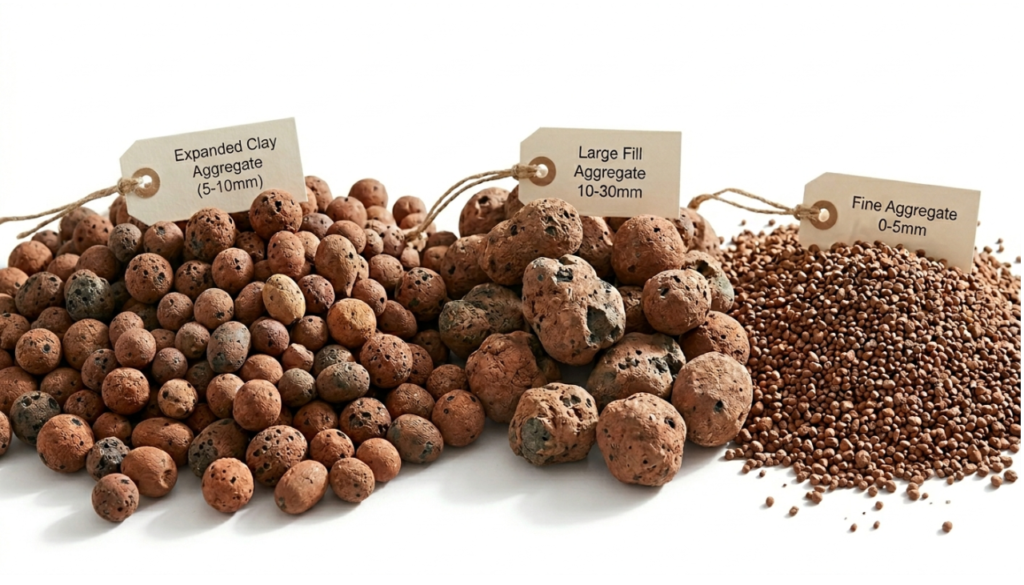
Product Description
Expanded clay is a lightweight, porous, and highly eco-friendly construction material produced by the rapid thermal firing of easily fusible clay deposits at extreme temperatures. Thanks to its unique cellular core structure and dense, vitrified outer shell, it seamlessly combines an exceptionally low weight with outstanding thermal and acoustic insulation performance. It is a versatile, long-lasting aggregate that does not rot, burn, or degrade under chemical exposure.
Product Application
Expanded clay is a multifunctional material widely utilized across various construction, engineering, and agricultural sectors:
- Residential & Civil Construction: Employed as a lightweight aggregate for structural and insulating concrete (expanded clay concrete) and masonry wall blocks, drastically reducing the total structural weight without compromising overall load-bearing capacity.
- Flooring & Structural Ceilings: Ideally suited for building lightweight thermal insulation screeds, loose-fill dry floor systems, and insulating intermediate floors, attics, and sloped loft spaces.
- Infrastructure & Utility Networks: Used as an efficient backfill thermal insulation barrier for building foundations, basements, retaining walls, and underground heating pipelines to minimize regional heat losses.
- Road Construction: Applied to create specialized lightweight drainage and frost-resistant insulating layers in embankments for highways and railways, particularly over soft, waterlogged, or shifting soils.
- Landscape Architecture: Used as a decorative ground cover for flower beds, alpine rock gardens, pathways, and to shield the topsoil from excessive evaporation and weed growth.
- Horticulture & Agriculture: Serves as a clean, eco-safe drainage layer for plant root systems in indoor floriculture, greenhouse farming, and hydroponics, optimizing the vital water-air balance.
Technical Specifications
- Grading / Fraction Sizes: 0–5 mm (expanded clay sand), 5–10 mm, 10–20 mm, 20–40 mm (gravel/coarse aggregate).
- Bulk Density: $300 \text{ to } 450 \text{ kg/m}^3$ (depending directly on the fraction size and strength grade).
- Thermal Conductivity: $\lambda = 0.10 – 0.18 \text{ W/(m·K)}$.
- Crushing / Compressive Strength: $1.0 \text{ to } 5.5 \text{ MPa}$ (grades ranging from P35 to P125).
- Fire Classification: Class A1 (Completely non-combustible material; withstands exposure temperatures exceeding 1000°C).
- Frost Resistance: Exceeds 25 complete freeze-thaw cycles (F25 status).
- Sulfate Content (as $\text{SO}_3$): 0.3%
- Eco-Safety: 100% natural composition with zero toxicity and background radioactivity.
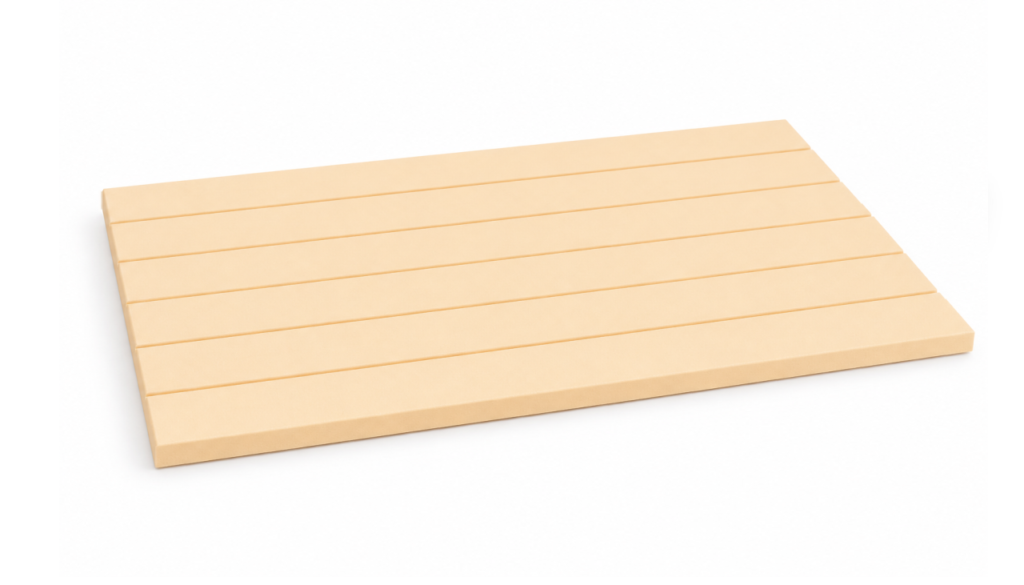
Extruded Polystyrene XPS (Straight Edge)
Product Description
Extruded polystyrene (XPS) with a straight, smooth edge configuration. These boards are designed to butt tightly against one another during installation. They are perfectly optimized for single-layer thermal lining on perfectly flat substrates or for heavy-duty multi-layer insulation systems installed with staggered, offset joints to minimize thermal bridging.
Product Application
Characterized by an exceptionally high compressive strength and superb resistance to chemically aggressive subterranean environments, XPS is an indispensable element in heavy civil and commercial engineering:
- Foundations & Plinths (Basements): Provides robust, long-term protection for underground structures against deep soil freezing, frost heave, and direct hydrostatic groundwater pressure.
- Flooring Systems: Serves as the ultimate rigid substrate beneath heavy concrete screeds, high-load industrial floors, and integrated radiant underfloor heating systems.
- All Roof Configurations: Ideal thermal solution for conventional flat roofs, inversion (inverted) roofs, ballasted trafficable decks, and extensive green roofs.
- Walls & Facades: Highly effective as core thermal insulation inside cavity walls (three-layer masonry), as well as exterior insulation for walk-out basements and plinths beneath protective render/stucco systems.
- Infrastructure Engineering: Acts as a heavy-duty frost-protection barrier preventing frost heave under highway pavements, airport runways, and railway track beds.
Technical Specifications
- Thickness Range: 20–100 mm
- Thermal Conductivity: Ultra-low coefficient (lambda = 0.029 – 0.034 W/(m·K), guaranteeing maximum energy retention.
- Water Absorption: Virtually zero (less than 0.3%–0.5% by volume); the material maintains 100% of its thermal resistance even when fully submerged or exposed to saturated soil.
- Compressive Strength: High-load capacity (ranging from 200 to 500 kPa at 10% structural deformation), easily withstanding continuous structural and mechanical loads.
- Apparent Density: 25 – 38 kg/m3 (Note: This optimal density range ensures the perfect equilibrium between maximum compressive resistance and ultra-low thermal conductivity).
- Temperature Operational Range: Stable performance under extreme environmental fluctuations from -50 °C up to +75 °C.
- Effective Service Life: Exceeds 50 years of continuous operation within structural assemblies.
- Eco-Safety & Bio-Resistance: Safe for human health, entirely chemically inert, and fully resistant to decay, mold, mildew, and microbial growth.
System Purpose
Advanced floor insulation executes several vital structural and thermal functions within a building’s envelope:
- Heat Retention: Minimizes thermal energy losses through the floor deck, substantially decreasing seasonal utility bills while stabilizing the indoor climate.
- Cold & Moisture Barrier: Blocks cold migration—especially upward from the ground in slab-on-grade foundations or unheated crawlspaces/basements—while functioning as an integrated hydro- and vapor barrier.
- Condensation Prevention: Eliminates the extreme temperature differentials on the subfloor surface, mitigating the risk of dew point formation, dampness, and subsequent toxic mold or mildew.
- Acoustic Protection: Provides heavy-duty sound dampening against impact noise (footsteps, dropping objects) and airborne noise between building levels.
- Rigid & Stable Base: Utilizing high-load, rigid insulation panels delivers a perfectly stable, unyielding substrate engineered to support heavy concrete floor screeds or final structural coverings.
Key Applications
Modern floor insulation systems are essential for any architectural design, with specialized material requirements depending on the subfloor location:
- Slab-on-Grade / Ground Floors: Demands extreme moisture resistance, near-zero water absorption, and exceptionally high compressive strength to withstand constant soil hydrostatic pressure and long-term structural settling.
- Inter-Story Floors (Between Levels): Focuses heavily on superior sound attenuation (specifically dampening heavy impact sound transmission) and optimized, low-profile material thickness to preserve structural room height.
- Trafficable Decks & Balconies: Requires heavy-duty insulation panels engineered to resist aggressive ambient weather elements and bear continuous mechanical loads during service life.
- Radiant Underfloor Heating Systems: Proper floor insulation is critically vital here to ensure that thermal energy from heating pipes or electric cables is driven strictly upward into the living space, preventing wasteful downward heat migration into the concrete support slab.
Frequently Asked Questions
Which floor insulation should I choose: rigid structural panels or flexible mineral wool?
Your selection depends entirely on the mechanical loading conditions of your floor assembly:
- Flexible Mineral Wool (Lightweight Insulation): Optimized strictly for non-load-bearing designs. This includes filling empty structural cavities between wooden joists, timber floor beams, or non-trafficable attic floors.
- Rigid Panels (High-Density Stone Wool, XPS): Engineered specifically for high-load, heavy-duty applications. These are mandatory beneath concrete floating screeds, slab-on-grade ground floors, and industrial flooring where supreme compressive strength is required.